Maximo Open Forum

 View Only
Expand all | Collapse all

Definition of Asset in IBM Maximo and the impact of over-assetization

  • 1.  Definition of Asset in IBM Maximo and the impact of over-assetization

    Posted 4 days ago

    Hello everyone,

    I am relatively new to IBM Maximo, and I would like to seek clarification on a topic where there seems to be different interpretations within our team regarding the definition of an "Asset."

    In our current discussion, there is a proposal to model almost everything as an Asset and LRU, including very small components such as auxiliary relays, fuses, and similar minor devices.

    My understanding, however, is that not everything installed in the system should necessarily be modeled as an Asset, and that Maximo has a specific design intent behind the Asset concept.

    With that in mind, I would like to ask the following questions:

    1. From a Maximo best-practice perspective, what is the formal definition of an "Asset"?

      • Is an Asset primarily defined by factors such as cost, criticality, maintainability, downtime impact, or lifecycle tracking?

    2. What types of equipment or components should be modeled as Assets, and which ones are better modeled as:

      • Locations

      • Components or subcomponents

      • Reference or non-maintainable records

    3. In real-world implementations, especially in infrastructure, utilities, or railway systems, what criteria do you typically use to decide:

      • "This should be an Asset"

      • versus "This should not be an Asset"

    4. What are the potential consequences of modeling everything as an Asset or LRU?

      • Impact on CM and PM workload

      • Failure reporting and data quality

      • System usability and performance

      • Asset lifecycle management, replacement strategy, and KPI reporting

    We are concerned that over-assetization may lead to long-term challenges in maintenance strategy, failure analysis, and overall data quality.

    I would greatly appreciate insights from IBM experts, consultants, and experienced Maximo users.

    Thank you very much.


    #Assets

    ------------------------------
    Suwichak Sangwanna
    JTT
    ------------------------------


  • 2.  RE: Definition of Asset in IBM Maximo and the impact of over-assetization

    Posted 3 days ago

    Some guidelines I've typically used:

    • (I'd say this one is by far the most important) if you want to make Work Orders against the "thing" (the physical object) so that you can track costs, see a history of repairs, list spare parts that would be used to repair it, etc. then it's an Asset; 
    • if that thing broke and you would simply, almost always, replace it instead of repair it, then it is not an Asset, it is an Item;
    • if it has a serial number, then it probably is an Asset, quite possibly a Rotating Asset (with a notable exception for us being small electric motors, which we would simply replace when they fail, therefore we treat them as consumable spare part/Items);
    • if you have more than one of that thing, and you need to be able to track each one individually (such as where it was deployed/installed, or who checked it out from a tool crib), you'll want to make Rotating Assets

    That said, about 4 years ago, we were considering moving to a certain rival system.  In their product demo they used a window crank as an example of an Asset.  I was astounded and it made me question my beliefs. . .and I still haven't fully decided if it makes me want to change my philosophy, but I do still have the question lingering in my mind like the OP here.  Why would a window crank be an Asset?  We don't even have the windows as Assets, much less a window crank!  Ultimately, I think that (at least for my org's needs) I wouldn't ever need to track repairs against a specific window, therefore the window should simply be an Item record -- with a proper Classification, with proper Attributes, so that I can track its Height, Width, Thickness, etc.; Vendors that we can buy it from and the cost of it; and associate that window to the room (which, for us, our Facilities/Buildings are our greatest Asset, so for every Location I have a matching/corresponding Asset, so I can associate spare parts to an Asset-Location) and the quantity thereof.

    But we are looking at a few use-cases of tracking non-serial-numbered things as Assets, such as residential roofs, so we can specifically tie Work Orders to the roof Asset rather than more generally to the Location where it would be mixed in among all other repairs at that Location; we could track expected life, repair history, and plan for replacement; track Attributes specific to the roof; and simply track when it was replaced.

    The obvious drawback is the more things that are Assets, that's more data that needs to be managed.  More lifecycles to deal with, more things to have to make sure that when the thing is physically replaced in real life then someone needs to make sure it is replaced digitally as well, more PMs and Routes to have to adjust to make sure you don't end up trying to make Work Orders against Assets that were replaced and scrapped, etc.

    For your use-case, I would want to know what you use for procurement (if not Maximo) and accounting, and how tightly those systems are integrated to Maximo.  If you ask your accounting team, they will probably have a strong opinion of what should (and what should not) be an asset.  If you expand your definition too wide, start making lots of Asset records in Maximo, and an integration starts adding things to their system(s) that messes up their workflows and reports, . . .well, I'd advise just avoiding that conflict.


    ------------------------------
    Travis Herron
    Pensacola Christian College
    ------------------------------


  • 3.  RE: Definition of Asset in IBM Maximo and the impact of over-assetization

    Posted yesterday

    Hi Travis,

    Thank you very much for your explanations so far - they've been very helpful. I'd like to ask a follow-up question based on a real implementation challenge I'm currently facing, to make sure I'm applying Maximo's design intent correctly.

    Previously, I was responsible for CM/PM using our client's SAP system. This year, the client decided to migrate to IBM Maximo, and a system integrator was engaged to support the implementation. However, I was asked to define and build the Location, Asset, and Work Management data model, because the integrator does not have detailed knowledge of the actual field equipment and layout.

    From my understanding, Assets in Maximo are typically equipment or components that we intend to maintain, repair, track lifecycle history, and potentially relocate.

    In our case, we have 24kV Ring Main Units (RMU). Inside a single RMU cabinet, there are components such as:

    • LBS

    • Power fuses / PT fuses

    • Protection relays

    • CTs / VTs

    The client's expectation (based on guidance from the integrator) is that:

    • Every internal component should be created as an Asset, and

    • Each Asset should have its own 1:1 Location, even for items physically installed inside the RMU cabinet.

    For example:

    • RMU cabinet Location: PP01-CONN-PSY-MVD-RMU1-HR11

    • Fuse Location (inside the same cabinet): PP01-CONN-PSY-MVD-RMU1-HR11F

    This is where I'm struggling conceptually.

    My concerns are:

    • Consumable items such as power fuses and PT fuses are typically replaced rather than repaired. Should these really be modeled as Assets?

    • When a fuse fails, the RMU itself is unavailable, so operationally the downtime is attributed to the RMU, not to the fuse as an independent entity.

    • Since these components are physically installed inside the cabinet and do not have a separate physical location, creating a separate Location for each internal component feels artificial and adds significant complexity.

    • I also struggle with the idea that Asset Numbers must strictly mirror Location codes. In practice, technicians find assets by Location, not by memorizing hundreds or thousands of Asset Numbers.

    This leads to a larger question:

    Is it truly a Maximo best practice that every Asset must have a 1:1 Location, even for internal components of a cabinet?

    Or would it be more aligned with Maximo's design intent to:

    • Use a single Location for the RMU cabinet, and

    • Model maintainable internal equipment as child Assets, while treating consumables (such as fuses) as Items and recording downtime at the RMU level?

    I'm concerned that enforcing a strict "1 Asset = 1 Location" rule will lead to over-assetization, excessive hierarchy growth, increased PM/CM overhead, and long-term data quality issues.

    I would really appreciate your perspective on how you would model this in real-world utility or infrastructure environments.

    Thank you again for sharing your experience.


    ------------------------------
    Suwichak Sangwanna
    JTT
    ------------------------------


  • 4.  RE: Definition of Asset in IBM Maximo and the impact of over-assetization

    Posted 3 days ago

    Hi Suwichak,

    Naviam had a blog written about Assets or Locations and why you need them both. There is an explanation of what each are, Give it a read and see if this helps.

    https://www.naviam.io/resources/blog/locations-or-assets---why-you-need-them-both?redirected&brand=projetech


    ------------------------------
    Allan Henle
    Naviam
    ------------------------------


  • 5.  RE: Definition of Asset in IBM Maximo and the impact of over-assetization

    Posted yesterday

    Hi Allan,

    Thank you very much for your explanations so far - they've been very helpful. I'd like to ask a follow-up question based on a real implementation challenge I'm currently facing, to make sure I'm applying Maximo's design intent correctly.

    Previously, I was responsible for CM/PM using our client's SAP system. This year, the client decided to migrate to IBM Maximo, and a system integrator was engaged to support the implementation. However, I was asked to define and build the Location, Asset, and Work Management data model, because the integrator does not have detailed knowledge of the actual field equipment and layout.

    From my understanding, Assets in Maximo are typically equipment or components that we intend to maintain, repair, track lifecycle history, and potentially relocate.

    In our case, we have 24kV Ring Main Units (RMU). Inside a single RMU cabinet, there are components such as:

    • LBS

    • Power fuses / PT fuses

    • Protection relays

    • CTs / VTs

    The client's expectation (based on guidance from the integrator) is that:

    • Every internal component should be created as an Asset, and

    • Each Asset should have its own 1:1 Location, even for items physically installed inside the RMU cabinet.

    For example:

    • RMU cabinet Location: PP01-CONN-PSY-MVD-RMU1-HR11

    • Fuse Location (inside the same cabinet): PP01-CONN-PSY-MVD-RMU1-HR11F

    This is where I'm struggling conceptually.

    My concerns are:

    • Consumable items such as power fuses and PT fuses are typically replaced rather than repaired. Should these really be modeled as Assets?

    • When a fuse fails, the RMU itself is unavailable, so operationally the downtime is attributed to the RMU, not to the fuse as an independent entity.

    • Since these components are physically installed inside the cabinet and do not have a separate physical location, creating a separate Location for each internal component feels artificial and adds significant complexity.

    • I also struggle with the idea that Asset Numbers must strictly mirror Location codes. In practice, technicians find assets by Location, not by memorizing hundreds or thousands of Asset Numbers.

    This leads to a larger question:

    Is it truly a Maximo best practice that every Asset must have a 1:1 Location, even for internal components of a cabinet?

    Or would it be more aligned with Maximo's design intent to:

    • Use a single Location for the RMU cabinet, and

    • Model maintainable internal equipment as child Assets, while treating consumables (such as fuses) as Items and recording downtime at the RMU level?

    I'm concerned that enforcing a strict "1 Asset = 1 Location" rule will lead to over-assetization, excessive hierarchy growth, increased PM/CM overhead, and long-term data quality issues.

    I would really appreciate your perspective on how you would model this in real-world utility or infrastructure environments.

    Thank you again for sharing your experience.


    ------------------------------
    Suwichak Sangwanna
    JTT
    ------------------------------


  • 6.  RE: Definition of Asset in IBM Maximo and the impact of over-assetization

    Posted yesterday

    Suwichak,

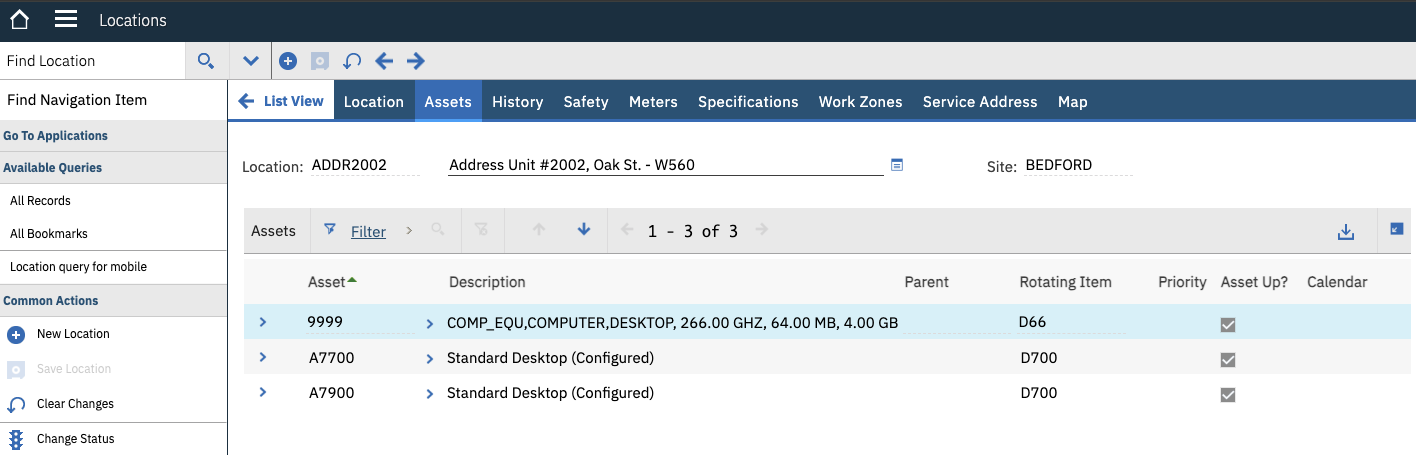
    I'd like to clarify that I am not an implementation expert. However, based on what I am reading here I would likely move towards a setup where the RMU is an asset - which is in a location. Then components within the RMU would be listed as items. You could then add the components, like a fuse, as a spare part to the RMU asset. You can also have multiple assets within 1 location, so a 1 Asset = 1 Location does not fully make sense to me. However, that can be a business decision. here is a screenshot from Demo Data:

    Inventory items would be place within a Storeroom in Maximo. Which is similar to a location, but has a different purpose. Storerooms are specialized Locations used specifically to manage inventory, tracking balances, and financial costs for items. Conversely, Locations (typically Operating) represent functional areas where assets reside, perform work, or are repaired.

    I hope this helps continue to clear up the path you and your business are working on.


    ------------------------------
    Allan Henle
    Naviam
    ------------------------------


  • 7.  RE: Definition of Asset in IBM Maximo and the impact of over-assetization

    Posted 13 hours ago

    I absolutely love this question.  I've been wrestling with it a lot lately as I consider adding more Systems.  Here's one I've been pondering:

    We've got a guy who is on the cusp of retirement that has this 3" (maybe thicker!) book full of pictures showing where all the components of the fire sprinkler systems are in each building.  I'll just use the building I'm in as an example.  There's a room downstairs that we simply call "the fire pump room."  So there's a Location (AD1FIREPUMP), which is part of the Primary Location hierarchy under MAIN (Main Campus) --> AD (Administration Building) --> AD1 (Administration Building First Floor).  That part seems easily understood.

    In that Fire Pump Room, there are several Assets, not just the Fire Pump.  There are electrical panels, a transformer, the fire pump, its motor, controller, jockey pump and its motor, and a backup generator.

    So if I wanted to include this in a new FIRESPRINKLER Location System, I'd surely include MAIN, AD, AD1, and AD1FIREPUMP.  But then I'd want to include which Assets belong in the System.  For example, the transformer in that room isn't really directly a component of the sprinkler system; I'd want my System to just include the locations of the pump, the standpipes, the shutoff valves, etc.

    Look back to that Naviam article that Allan linked to above.  In it, it has this example:
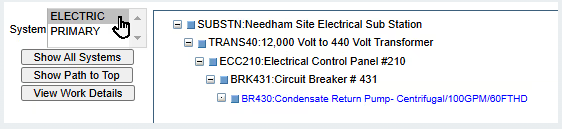
    When I look at that, my initial reaction is, "Why would you have something like TRANS40 as a Location?  That's an Asset!  And what are you going to do if, say, you updated your electrical grid and that transformer changes, like it's not 12000V to 440V anymore?"

    I suspect what's going on there is that while the Location SUBSTN seems like an actual, physical place, the Locations like TRANS40, ECC210, BRK431, and BR430 are more like logical placeholders for Assets.  So you'd have an Asset record for the 12000V--440V Transformer, with its serial number, etc., and you'd assign it to Location = TRANS40.

    The downside to that is if I go to look at all the Assets in a physical Location, such as SUBSTN in this example, I wouldn't (directly) see it there.

    I really wish that Assets had Systems the way Locations do.  It seems more logical to me that you'd want to get to a physical place (Location), observe the Assets there (electrical panel, transformer, pump, motor, etc.), and understand why those Assets are there (e.g. the electrical panel and transformer are part of the ELECTRICAL system, the fire pump is part of the SPRINKLER system, etc.).  

    Alternatively, Assets do have the ability to create custom RELATIONSHIPS -- and this is a relatively new feature, I think introduced in 7.6.x. I haven't done this yet IRL, so maybe this is a dumb example, but maybe I'd have a flow switch on the 4th floor mechanical room (Location = AD4MECH, and the flow switch is an Asset in that Location), a custom relationship called ACTIVATES, and connect my two Assets as 

    the flow switch Asset (which is in Location=AD4MECH)   ACTIVATES    the fire pump (which is in Location=AD1FIREPUMP).

    This is done in the Assets application, Relationship tab.  In this way, it's at least kind of like creating Asset Systems.  I think this is going to end up being a better approach than the one in the picture above, at least for my use case.  Would love to hear others' input and advice!

    Suwichak, I know this doesn't directly answer your question, but I think you could take this concept and apply it to your use case.

    >>Is it truly a Maximo best practice that every Asset must have a 1:1 Location, even for internal components of a cabinet?

    I'd say no.  If that were the case, IBM probably would have automated creating a Location every time you make an Asset and vice versa.

    I'm not sure how SAP works, but I will add that in the last few years I've been through a few dozen product demos as we consider whether or not our org is going to keep Maximo.  In several of these CMMS, EAM, or IWMS systems, there was no distinction between Locations and Assets.  Everything was simply an Asset, and everything connected into one hierarchy.  Maximo offers a lot more flexibility. . .which can also mean complexity and confusion.  It's definitely good that you're asking questions and planning first before implementing!


    ------------------------------
    Travis Herron
    Pensacola Christian College
    ------------------------------


  • 8.  RE: Definition of Asset in IBM Maximo and the impact of over-assetization

    Posted an hour ago
    Hi Travis,
     
    Thank you very much for the thoughtful explanation - your examples really helped clarify how Locations and Assets can be viewed differently depending on system context.
     
    What resonated most with me is your point that Locations are not always purely physical places, and that some implementations use Locations as logical placeholders for Assets. I agree that this flexibility is one of Maximo's strengths - but also one of its biggest risks if not governed carefully.
     
    In our case, the challenge we are facing is not so much the data model itself, but how Location granularity directly influences user behavior, especially when recording corrective maintenance and downtime.
     
    We are seeing that once internal cabinet components (e.g. fuses, protection relays) are given their own Locations, users are unintentionally guided to record downtime at the component level - even when the functional unit (RMU or UPS) remains operational.
     
    Your observation that Maximo does not enforce a strict 1:1 Asset–Location rule aligns with our understanding as well. If that were a hard best practice, as you said, Maximo would likely automate that relationship.
     
    I appreciate you sharing your thought process - it has helped me better articulate the difference between structural flexibility and operational data integrity, which is the core issue we are trying to balance.
     
    Thanks again for taking the time to respond.


    ------------------------------
    Suwichak Sangwanna
    JTT
    ------------------------------


  • 9.  RE: Definition of Asset in IBM Maximo and the impact of over-assetization

    Posted an hour ago
    Hi Allan,
     
    Thank you for sharing the Naviam article - it was a useful reference and helped frame the discussion around why both Assets and Locations are needed in Maximo.
     
    The distinction made in the article between spatial context (Location) and maintainable entities (Assets) is something we fully agree with.
     
    One area we are still carefully evaluating, however, is how far that distinction should be pushed at the component level - particularly inside cabinets such as RMUs and UPS systems.
     
    From an operational standpoint, we are seeing that overly granular Locations can unintentionally drive incorrect downtime attribution, even when the article's conceptual model is sound.
     
    The blog was definitely helpful in validating the need for both constructs - our ongoing challenge is ensuring that their usage supports long-term data quality and operational decision-making.
     
    Thanks again for pointing us to that resource.


    ------------------------------
    Suwichak Sangwanna
    JTT
    ------------------------------


  • 10.  RE: Definition of Asset in IBM Maximo and the impact of over-assetization

    Posted 7 hours ago

    We have ended up in exactly this position following the recommendation of 1:1 Location/Assets. I'm keen to rethink this more along the SAP lines where MAS Location = SAP FLOC, MAS Asset and Children Assets = SAP Equipment, and MAS Asset Item = SAP BOM. I would see a location hierarchy for a generator possibly for something like Building>Generation Floor>Generator Unit >Generator, then into the Asset hierarchy, Generator>Slip ring>Brush gear into the Items list>Brushgear holder, Springs, Brushes, etc.


    ------------------------------
    Craig Webber
    Mercury NZ
    ------------------------------


  • 11.  RE: Definition of Asset in IBM Maximo and the impact of over-assetization

    Posted an hour ago

    Hi Craig,

    Thank you for sharing your experience it's very helpful to hear from someone who has already gone through the 1:1 Location/Asset approach and is now reconsidering it.

    The comparison you made to SAP (FLOC vs Equipment vs BOM) is particularly relevant to our situation, as many of us came from SAP-based maintenance models before moving to Maximo.

    I strongly agree with your point that Location hierarchy should primarily represent physical or functional context, while Assets and their children represent maintainable equipment, and Items represent consumables or BOM components.

    In our electrical systems (RMUs and UPSs), we are finding that over-granular Locations quickly lead to:

    • fragmented downtime
    • confusing CM history
    • and difficulty answering simple questions like "Did this RMU actually cause an outage?"

    Your generator example mirrors what we are trying to achieve: clear functional Locations, meaningful Asset hierarchies, and Items where replacement not repair is the norm.

    It's reassuring to see others reaching similar conclusions after real operational experience. Thanks again for contributing your perspective.


    ------------------------------
    Suwichak Sangwanna
    JTT
    ------------------------------